"Life is about not knowing, having to change, taking the moment and making the best of it without knowing what's going to happen next."

Thursday, May 13, 2010

Happy Mother's Day

To all you wonderful mother's: Have a wonderful Mother's Day. You are the best


We went to a big festival on Mother's Day. I got lily's for my love, we watched basketball, break dancing, got a free hair setting, ECO friendly stickers, and the boys are supposed to get mommy Tacoyaki from the store tomorrow.

Children's Day

Here, the boys are eating Turkish icecream for the first time.


Everyone remembers BaskinRobins day, the only day in a year, just about, that you can get a free pick from a wide assortment of icecreams. That photo on the left is behind one of the shops in Namba. We went twice. Well, Fay wanted it, and it was Mother's Day, so I said fine


This was a special meal that River made for the boys for Children's Day. This is like the first time in my life that I'm celebrating all of these day's. There was Ampanman cake, Koinobori cake, and awesomely tasty sandwiches.


That on the left was just a special snack that mommy made for the boys. And that's a close-up of the Koinobori cake for Children's Day


Happy Mother's Day

From Yushi and Fay: We love you and think you look very pretty

Sunday, May 2, 2010

Osaka Castle

大阪城(Osaka Castle)

組太鼓kumi-daiko or 和太鼓wa-daiko(Japanese drum)
I'm not really into the traditional Japanese drums, but the way some of these 大学生(university students) get a kick out of it is awesome to see. They can spend from 1 hour to 2 hours paddling those things, and then rest a little and start a whole new round. And they really get into it. I mean, REALLY!

Biggest Rock used for wall
This stone wall was built during the early Edo period in 1624, by Tadao Ikeda, feudal lord of Okayama, who was ordered to take charge of this part of the premises by the Tokugawa shogunate. This stone in the front is known as Takoishi, literally, an octopus stone, and is the largest stone in the Osaka Castle, measuring 50.43 square meters in surface area and 708t in estimated weight.

We went to the castle park to witness

These sites and sounds are our back yard

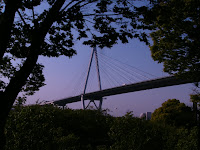
Pics of Hanshin Expressway from Tempozan park. At night it's really beautiful!
               
View from boat. Pretty awesome--all the time

Saturday, May 1, 2010

 Tempozan
Tenpō (天保山, Tenpōzan?) located in Minato-ku, Osaka is commonly recognized as Japan's lowest mountain. The definition of a "mountain" used here is any elevation described as a mountain on a topographic map published by the Geographical Survey Institute of Japan, though it is disputed that the mountain lacks credibility because it is not a natural part of the landscape. The mountain's "peak" is 4.53 meters above sea level, and will bear more resemblance to a hill than a mountain to the casual observer. A small port is located nearby, and much of the mountain's surface has been converted into a park.

Boat Trip
There is a free boat ride from the other side of Tempozan park to a port near USJ (Universal Studio Japan)


 鯉幟(koinobori)

Koinobori (鯉幟, Koi-nobori?), meaning "carp streamer" in Japanese, are carp-shaped wind socks traditionally flown in Japan to celebrate Tango no Sekku (端午の節句), a traditional calendrical event which is now designated a National holiday; Children's Day[1]. These wind socks are made by drawing carp patterns on paper, cloth or other nonwoven fabric. They are then allowed to flutter in the wind. They are also known as satsuki-nobori (皐幟?).

Wednesday, April 28, 2010

Tempozan Sunset

View a beautiful sunset from Tempozan
Tenpozan Harbor Village is famous for offering one of the most beautiful sunsets in Japan. It is located where the Aji River flows into Osaka Bay. The surrounding area has been developed as a modern port, "Osaka Port & Harbor."
Tenpozan Harbor Village offers an excellent view of Mt.Rokko to the north (right), Awaji Island across the bay in the west (front), and skyscrapers at Nanko Cosmosquare to the south (left).

Shabu-shabu

Background
Shabu-shabu (しゃぶしゃぶ, , also spelled syabu-syabu?) is a Japanese variant of hot pot. The dish is related to sukiyaki in style, where both use thinly sliced meat and vegetables, and usually served with dipping sauces, but it is considered to be more savory and less sweet than sukiyaki. It is considered a winter dish but is eaten year-round
Shabu-shabu was introduced in Japan in the 20th century with the opening of a Shabu-shabu restaurant "Suehiro"[1] in Osaka. Its origins are traced back to the Chinese hot pot known as "shuan yang rou". Shabu-shabu is most similar to the original Chinese version when compared to other Japanese steamboat dishes (nabemono) such as sukiyaki. The name of Shabu-shabu was named when Suehiro served it. After that, Suehiro registered the name of shabu-shabu as a trademark in 1955. The cuisine rapidly spread through Asia[citation needed]. Together with sukiyaki, shabu-shabu is a common dish in tourist hot-spots, especially in Tokyo, but also in local Japanese neighborhoods (colloquially called "Little Tokyos" or "Japantowns") in countries such as the United States and Canada.

Thursday, April 22, 2010

Finger Paints

These are one of those educational toys that are extremely messy; that you'd want to be sure to keep out of your kids reach. Kids can take the 6 available colors and make a huge disaster somewhere. The reason I am posting this is because I thought it was funny how in the instructions it cautions its buyers to only let ages 3 through 105 play with it.

食べ放題 (Tabehoudai)


This was a fun little outing that we had to celebrate our new home and the Sakura season that we worked hard in. The attraction of this restaurant was its buffet, Gelato icecream, and the order of two kinds of pasta and 5 other awesome dishes for an extra ¥100. It also had a sweets corner with brownies, puddings, jelly's, and a chocolate fountain. The price was a meager 999 yen per person, and 499 for kids, I think. Great food! And thank you Jesus!